
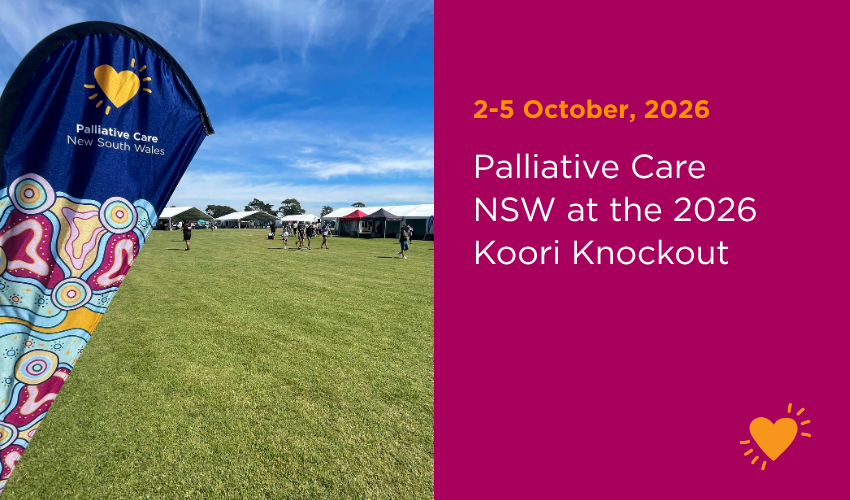
Over the October Long Weekend, Palliative Care NSW was honoured to be invited to the 2026 Koori Knockout in Raymond Terrace, joining thousands of community members at one of the largest gatherings of Aboriginal people in Australia. As part of the Gudida Wellbeing Precinct, Palliative Care NSW worked alongside key partners to provide information, resources and support in a welcoming and culturally safe environment.
Representing Palliative Care NSW were Megan Asbury, Deputy CEO and Anthony Bui, Community Engagement & Programs Coordinator who worked alongside Sonya Parter, Senior Policy Officer, Carers, End of Life and Palliative Care Team, NSW Ministry of Health, and Tennille McCormack, Aboriginal Health Worker and Transitional Nurse Practitioner from Medical and Interventional Services, John Hunter Hospital. Together, the team engaged with community members in conversations about future health care planning, palliative care and end-of-life care.
The Gudida Wellbeing Precinct provided the perfect setting for these discussions. In the local language, Gudida means family, reflecting the importance of connection, care and support within Aboriginal and Torres Strait Islander communities. Family is also at the heart of palliative care, making the precinct a natural place to encourage meaningful conversations about planning ahead and ensuring that individual wishes are understood and respected.
The Gudida Wellbeing Precinct was the inaugural health precinct at the Koori Knockout, supported by the Cancer Institute NSW in partnership with the Newcastle Yowies and Worimi Local Aboriginal Land Council (LALC). The precinct brought together a range of health and wellbeing organisations, creating a dedicated space where community members could access information, ask questions and connect with services in a culturally safe and welcoming environment.
The Koori Knockout provided a valuable opportunity to connect directly with community members in a relaxed and engaging setting. Many visitors stopped by to learn more about what palliative care involves, why it is important and how it can support individuals and families. The strong interest from community members reinforced the importance of bringing information and support into community spaces and having these conversations in ways that are accessible, culturally appropriate and community-led.
Throughout the weekend, the team encouraged community members to think about what matters most to them and to share their wishes, values and preferences with loved ones. Future health care planning is about more than medical decisions, it is about ensuring family members understand a person’s priorities and that their voice remains central to decisions about their care. By having these conversations early, families can feel more confident and supported when important decisions need to be made.
Adding to the atmosphere was a heart cushion sewing activity, where community members could create their own handmade heart cushions. The activity proved to be a huge success, particularly among children, who eagerly returned throughout the weekend to make more cushions. PCNSW was located in the combined Elders and Jarjum tent, meaning we had the privilege of connecting with multiple generations of families with the children often staying to sew and yarn while their grandparents or parents rested in the shade. More than just a craft activity, the heart cushions created opportunities for connection, storytelling and conversation, bringing families together and reflecting the spirit of Gudida.
Palliative Care NSW would like to thank the organisers and community for welcoming us onto Worimi Country and into the inaugural Gudida Wellbeing Precinct. We are grateful to everyone who took the time to yarn, share knowledge and connect with our team throughout the weekend. It was a privilege to be part of such a special event and enjoy some great footy along the way.