
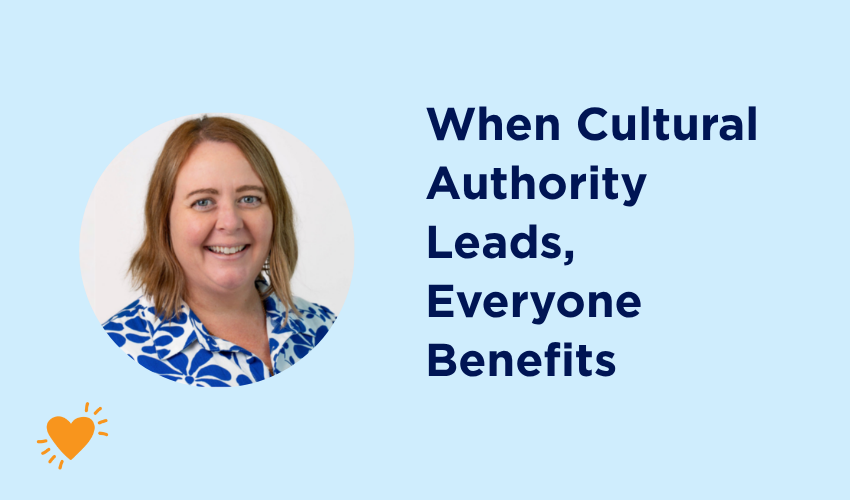
Get it right for Indigenous Australians, get it right for everyone. Kat Hooper (pictured) explains why cultural authority is the key to transforming end-of-life care.
When proud Woromi descendent and Nurse Practitioner Kat Hooper travels Queensland asking First Nations people what cultural safety looks like in palliative care, the answers are strikingly simple. They want to be validated. Aboriginal and Torres Strait Islander Peoples want to be respected and their voices heard. Traditional ways of doing, knowing, and being acknowledged in care systems.
It’s what anyone would want, really. Which is precisely her point.
“If we get it right for Aboriginal and Torres Strait Islander Peoples, we can get it right for everyone,” Kat says.
She’s spent years consulting with First Nations communities across Queensland, embedding cultural authority and cultural safety into palliative care systems, and proving that Indigenous-led approaches benefit everyone.
A $15 revolution
Ask Kat about the gap between what communities need and current practice, and she’ll tell you it seems gigantic. Then she’ll tell you it’s doable.
“Projectors are $15,” she says, matter-of-factly. “We can project star stories onto the roof. We can project Totems. We can project family photos, photos from country, individualise care.”
If unable to return to country before end of life, then bring country to the person. Soils and sands from Country to put their feet in. Water from Country to wash and cleanse the body and create a form of reconnection. It doesn’t need to cost much, but small things have the power to make a massive difference.
The impact has reached beyond Indigenous communities. When health services designed culturally safe care packages for Aboriginal and Torres Strait Islander people, other services wanted them too. The approaches resonated across cultures in multicultural Australia and similar colonised countries.
Tokenism to cultural authority
For too long, First Nations involvement in healthcare has been surface-level. Often systems and positions are designed for Aboriginal and Torres Strait Islanders to fit into, rather than community being consulted and a position tailored to benefit the communities. This is not a tick-box exercise that leaves Aboriginal and Torres Strait Islander staff feeling like tokens rather than authorities, and valuable cultural knowledge holders.
What Kat advocates for is deeper and goes beyond tokenism: cultural authority that’s embedded in policy and practice.
“Cultural authority when it’s embedded is so essential, because it really allows Aboriginal and Torres Strait Islander people to be self-governing,” she explains. “It speaks to their sovereign wisdom and their sovereign knowledges.”
This means Elders sitting on advisory panels, participating in multidisciplinary team meetings, leading through mentorship and preceptorship. At Royal Brisbane Hospital, elders in residence now provide cultural authority and wisdom that feeds into every layer of hospital care.
It’s about recognising that Eldership isn’t ceremonial. Rather, it’s integral to laws, customs, healing, and emotional support. It’s ensuring intergenerational wisdom passes from ancestors to future generations, preserving knowledge that keeps communities thriving.
An holistic lens
Typically, Western medicine doesn’t reflect the holistic concept of life or death. It’s a lens that doesn’t quite align with life from an Aboriginal and Torres Strait Islander perspective; a disconnect Kat argues is the reason illness persists and the gap continues to widen rather than bridging the gap.
She references the social and emotional wellbeing model. Connection to spirit and ancestors, to body, to mind and emotions, to family and kinship, to community, to culture, to country and land, and to spiritual reality. When care interventions address each of these connections, something shifts.
“We’re empowering that person. We’re trying to re-enable each First Nations person to be self-determined and nurture cultural identity, and through that we are working culturally responsively which fosters cultural safety,” Kat says.
It’s a model that moves away from deficit-based approaches focused solely on disease statistics and inequities. Those things matter – and bridging the gap requires addressing them – but the lens needs to widen to include cultural aspects as a strengths-based approach to feed into wellbeing.
Walking toward liberation
The progress is tangible. Kat says Aboriginal Health Workers are increasingly embedded in palliative care services, bridging gaps between communities and health systems. First Nations workforce, typically well-connected to the communities they serve, walk both worlds.
One example, Kat shares, is Gold Coast Hospital, where a family of 120 gathered as their loved one passed. There was celebration, prayers, singing, didgeridoo, smoking ceremonies, all facilitated by Aboriginal Health Workers who understood what was appropriate and made it happen.
That kind of support is changing the landscape, and there’s been a shift in how people engage with care.
First Nations people are increasingly accessing advanced care planning, says Kat. Some are choosing voluntary assisted dying, finding liberation in self-determination even as cultural and religious beliefs vary across communities.
Kat describes the evolution through a powerful visual: equality meant not many people could see over the fence. Equity added building blocks so each person could look over. Now, the work is moving toward liberation, removing the fence entirely.
“We’re putting things in place now where we’re moving towards liberation, where there’s no fence at all,” she says. “How can we all walk together, in two ways, to work now towards health liberation in palliative care?”
Beyond tokenism
The work isn’t finished. It requires truth-telling and understanding the trauma that exists, knowing what happened on the lands where you’re working while also recognising the layers of scars from massacres, Stolen Generations, stolen wages, and exposure to racism.
“If you’ve got the responsibility of caring for Aboriginal and Torres Strait Islander Peoples, you need to know exactly the generational scars that you’re caring for,” Kat says simply.
It requires moving beyond tokenism to genuine integration of cultural authority. It requires an understanding that connection to culture and country isn’t peripheral to health, but it is fundamental to it.
And perhaps most importantly, it requires understanding that Indigenous-led approaches to palliative care aren’t just for Indigenous people. They’re a framework that honours what it means to die well, no matter who you are.
This article was originally published on Monday, February 16, 2026 by Palliative Care Australia. and is reproduced with their permission. Written by Sarah Vercoe.