
Palliative care professionals walk alongside individuals navigating a life-limiting illness, supporting them and those closest to them to live well, die well, and grieve well. In doing so, they bear witness to one of life’s most profound transitions, and the many and varied responses to this.
Resilience is therefore not optional in this field; it is essential. Clinicians draw upon it for their own wellbeing, while also helping patients and families cultivate the inner resources needed to face what lies ahead.
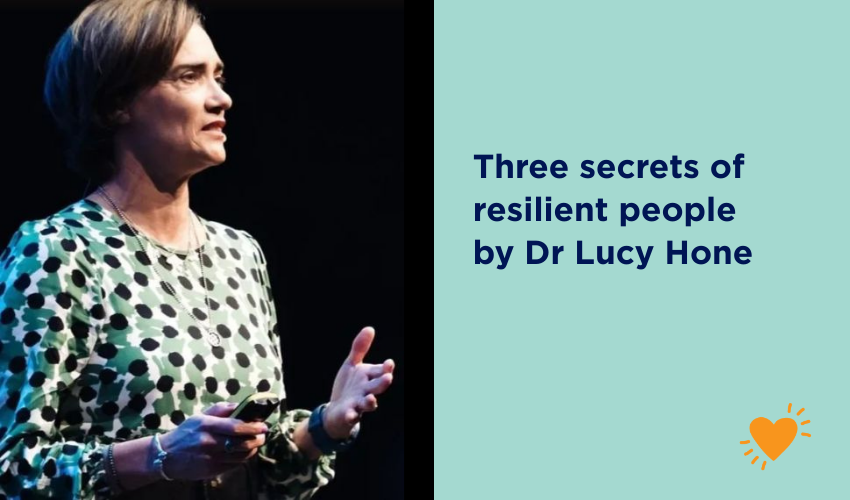
In her poignant TED Talk, The Three Secrets of Resilient People, Dr Lucy Hone, a resilience researcher and bereaved mother, offers evidence-based, deeply human strategies to cope with life’s most difficult times.
Her message is grounded in science and shaped by her journey through the devastating loss of her 12-year-old daughter. It speaks directly to those who witness grief up close and seek frameworks that acknowledge suffering without diminishing it.
1. Suffering is part of life
Dr Lucy’s first “secret” reframes resilience not as immunity to hardship but as realistic acceptance that suffering is part of life. In the talk she emphasises: “If you’re alive, you’re going to face some tough times.” This simple but essential truth helps guard against the isolating belief that someone who is hurting has somehow been uniquely singled out.
A framework that names hardship as universal, without minimising distress, can validate patients’ and families’ experiences while creating space for authentic coping.
2. Where You Place Your Attention Matters
The second insight focuses on intentional attention, deliberately noticing what can be changed and what’s meaningful, while accepting what cannot. Evolution wired humans to scan for threats; in modern life, that instinct can amplify stress and undermine wellbeing.
She cites research showing that a simple daily practice, such as listing three good things that happened, can boost gratitude and emotional resilience.
Supporting patients and families to find moments of connection, meaning, or gratitude, even amid decline or loss, can foster agency in the lived experience of illness.
For clinician wellbeing, intentional attention practices can counter burnout, compassion fatigue and the relentless focus on problems that can often dominate healthcare settings.
3. Ask: “Is What I’m Doing Helping or Harming Me?”
Perhaps the most practically powerful of the three strategies is the simple reflexive question: “Is this helping or harming me?” Dr Lucy notes that this question puts individuals “back in the driver’s seat,” giving them choice amidst their reactions, habits, and behaviours.
This reflective prompt is reminiscent of motivational interviewing and cognitive behavioural approaches, drawing attention to actions and thoughts that support wellbeing (or don’t).
It can also help families and patients slow the overwhelm and clarify decisions in emotionally charged situations.
Dt Lucy’s third secret, reflective evaluation of “helpful vs harmful” thoughts and behaviours, is a tool clinicians can also use to foster their own emotional sustainability.
Resilience is not about being unbreakable, nor the absence of pain; it is rather how we engage with it. The strategies mentioned above are learnable. While rooted in research, the strategies outlined by Dr Lucy, are accessible and actionable. This aligns with therapeutic work where capacity is built through small, meaningful moments, not forced optimism.
The journey through life-limiting illness and loss is uniquely human, and deeply relational. What Dr Lucy’s talk offers isn’t an instruction manual for avoiding grief, but a grounded invitation to engage with adversity less fearfully, more intentionally, and with greater compassion for self and others.
For health professionals in palliative care, her insights provide a framework for important reflections to support resilience, a bridge between science and human experience, grief and growth, pain and presence.
To watch the full Ted Talk, please click here.
Dr Lucy was also recently featured as a guest on The Waiting Room Revolution podcast. Hosts Dr Samantha Winemaker, a palliative care doctor, and Dr Hsien Seow, a healthcare researcher, speak with Dr Lucy about grief, loss, and how people can navigate life’s toughest moments with strength and compassion. The episode reinforces that while grief is a deeply personal journey, the way forward is often made possible through shared understanding, collective resilience, and compassionate connections. Listen to the episode here.